
Photos Provided by Artist
If you’re like most people reading this, then you’re probably fairly well versed in online bass content, which is most popularly consumed on social media. Regardless of whether it’s bass demos, song playthroughs, rig rundowns, or awe-inspiring show footage that you’re into, you most likely know who Vincen Garcia is. Born in Valenica, Spain, Garcia picked up the bass at the age of 16 and began posting videos in 2013. As his skill at soloing and anchoring complex grooves accelerated at a rapid rate, people start to take notice of him, which led to collaborations with other musicians and an increasing amount of concert requests. His online profile boomed and his playing began going viral across all of the social media platforms. His unique playing began to catch on in places far from Spain, where his 2023 debut album, Ventura, was highly anticipated and met with positive acclaim.
Short after the release of Ventura, Garcia was in contact with guitarist Cory Wong, who was about to leave for a European tour and got word at the last second that his bassist Sonny T was unable to make the trek due to personal reasons. With only 48 hours to learn Wong’s entire catalog, Garcia took on the challenge and ended up electrifying crowds with his inspired performances. Garcia is now currently in the middle of his own tour where he will make a stop to support Herbie Hancock in Spain after commanding key slots at the Montreux Jazz Festival and North Sea Jazz. When his tour concludes in August, he will head home to finish work on his sophomore album, which will see a 2026 release. We caught up with him on a recent stop to discuss everything he has on the horizon ahead and how remarkable it is for a player from a small corner of Spain to gain the kind of notoriety that he so deservedly has.

You’ve been having a big year so far. How has the 2025 tour been going for you?
It has been amazing in so many ways, especially how it started with playing the Montreux Jazz Festival last year. That had always been a dream of mine and I got the opportunity to play it. In Europe the people are really appreciative of music, and you can feel it onstage, and that fuels the music so much. I went on to play a lot of different festivals like the North Sea Jazz Festival and it was such a good experience to feel the audience truly be excited about what was happening onstage. The tour also had smaller venues on it, which I love equally because it is more intimate. The shows keep getting better, too.
You’re getting ready to play with Herbie Hancock. How excited are you?
It’s amazing. He’s coming to Madrid and I will be on the bill with him. I’ve been a fan of his music for so long and he’s such a legend. It’s really special to me that it’s in Spain too. I am very proud of that.
You’re currently working on your new album. What can you tell us about it?
When I’m working on music, I never say too much about it because it is not yet finished, and I want the music to have a chance to speak for itself. But I’m always writing and trying to push where the music goes into new places. I’m working on a new album that I’m going to release in 2026 so that I can do all of this touring and not rush any of it. But I do want to put the new material out there so that I have more to play live. I’m composing a lot of different ideas that are coming from my soul, and I’m taking what I’m feeling in the moment of composing them and writing from that.
How do you typically compose your music?
The last album I composed without bass and mainly used a keyboard so that I could get the melodies from my mind onto the track first. A lot of time I record melodies onto my phone so that I don’t forget them. But these new songs are coming a lot from bass. These ideas are very rhythmic so far, so I’m writing a lot of them on bass and then with guitar and keyboards. For me it depends on whether the melody sounds better on bass, guitar, or keys. That’s where the songs usually start for me and then I build around that. I create a lot of horn melodies too and I like layering them over each other.
You released your album Ventura in 2023. Did you feel pressure on that album because of all of your success and visibility online leading up to it?
Sometimes I speak about this with my manager, but of course I felt some pressure, but really I was focused on composing and taking my time. It was written and recorded entirely in my home studio and almost all of the instruments were recorded by me. I believe that people enjoyed it, but I was just trying to satisfy my own expectations. It was my first album, so it was my first chance to put music out there and let people hear that side of me. I didn’t imagine that my first album would ever be played outside of Spain. It was all a big surprise that it all happened so fast. Of course, I worked so hard for so long before any of this, but I thought it would take much longer for it to catch on. I’m super happy and I’m always with a smile because I love to play bass in life. It’s all I know how to do.
Do you prefer writing on your own or collaborating with other musicians?
I very much enjoy collaborating with people because the way I am doing it now is just me in my studio. But when I send someone tracks to play on, the musician plays in their own style and that inspires me in a different way. Then songs turn out differently than if I were just writing all of the parts. I like putting the bass on later in the process because it allows me to bring more melody and space to it. Having different musicians on songs actually gives me more freedom. I like to record drums first, then keyboard and guitars, and then bass. When you create the song and send it to the musician and receive it back, you’ll probably have a different opinion of the bass line. Then you have the opportunity to be the last one to record and you can add or subtract from it.
How do you usually track your bass and capture your sound?
Right now I run a line into an interface with a preamp. I love the sound of my bass and I try to keep it simple to have that come out in the recording. I don’t want it over mixed or over processed. I want my bass to sound as natural as possible.
You’re known for your soloing on bass. What are your keys to a good solo?
You need to start the bass solo with a long note or a simple phrase. I like for there to be an opening to the solo. Then in that moment I feel the melody and run through pentatonic scales usually and chords, and I love chromatic segues and melodic minors. It’s really all about what comes to you in the moment. I take it step by step and feel what’s happening with the musicians around me. You have to open your ears to be a good soloist.
You’re a very percussive slapper. Tell us about your technique.
My slapping is similar to how a drummer plays. I like to make it very rhythmic and complex. My technique with my right hand is aggressive, but I make sure not to use too much pressure, because when you slap too hard it isn’t good for the overall tone. It sounds cleaner when you use just the right amount of force. I don’t slap all of the time, only when it is appropriate. I mainly use the fingerstyle technique, and I apply palm muting a lot of the time for certain grooves.

What’s your ideal tone and how do you achieve it?
I love Jaco Pastorius’ sound because there was so much definition to it. I love big, low, booming tones, but it always has to have definition. I always use two pickup basses so that there’s more range. I like to have both the bridge and the neck pickup on to have more of a balanced tone in the middle. I like bright tones and treble, but not too much; I keep it maybe at 15%. I turn it up a little when I slap to get more reaction out of the bass.
How does the music of Spain influence your playing?
I do like to play flamenco, and I love the fusion and a lot of the music that comes from this area. All of my heroes like Jaco and Victor Wooten have always been very present in Europe, so those are major influences in my playing. I try to get into a little of everything, but I’m sure that side is always there for me in whatever I’m playing.
What was your experience like performing with Cory Wong?
It was a both a big experience for me and a very challenging one. He called me only two days before he started his tour and I had to learn 50 songs in 48 hours. I really love his music, but I hadn’t heard a lot of those songs. I didn’t need to play the exact bass lines, so I could go off of the key changes. It was a great experience for me in studying a lot of music really fast. All of the musicians were super nice and super talented. I’m truly thankful for the whole experience.
How did you go about learning 50 songs in 48 hours?
In this case I listened to all of the songs with my bass without stopping. I tried to get all of the melodies in my head so I could recognize them. I played along with the songs next and wrote some notes to remember changes. I slept very little and spent all of the rest of my time listening to the music. I did everything I could to prepare.
What was that first show like? Was it nerve wrecking going into that?
I was a little bit nervous. The first show was for a venue with 500 people, and I had four solos, so it was a little pressure. But I did it and it was good.

What do you love about your Yamaha basses?
For me, the basses they make are really comfortable to play and they give me everything that I want from my instrument. They have a big sound to them and a classic tone that cuts through. I can also dial them in to get a punchier sound like Jaco, with more mids. Yamaha made me my own bass with all of my specifications including the wood I wanted, the pickups, and the purple sparkle finish. This bass is very close to the sound I’ve always had in my mind. I went with the purple color because all of the basses I’d played were very standard colors like black or white and I decided I wanted something different. They prototyped that color and I loved it. And it has a relic finish to it, which I like. The wood is swamp ash, which I like for its tone, and it’s super light. The neck is maple, which I feel has more definition to it. I use a finger ramp because I first saw one on Hadrien Feraud’s Mayones bass and I thought it was a good idea.
You have a large social media following and big presence online. How important is that to an artist nowadays?
It really depends on the person, but for me, it helped me get visibility for my music. Before I started making videos I was working in other fields because the music wasn’t paying enough. I started making videos just for the sake of it and people started watching them. Coming from Spain, it’s a way for me to spread my music to anywhere in the world. And it’s cool to connect with people from all over the place. It’s also good for promoting shows and releases. I started making three videos a week and it became a chore and a little bit obsessive. Right now, for me, I just try to keep up on it and post performances from my shows. Of course, there’s a bad side because some people will make mean comments. But I find it good overall. I don’t want to be a content creator, I wish I could just make music, but it has become a part of what I do.
How and when did you first start playing bass?
I started playing bass when I was 16. I was a little late. In school some friends wanted to start a band and we were deciding who would play which instrument and I wanted to play bass. My parents are both musicians and I come from a musical family so they encouraged it. My dad got me an Academy Precision bass and a book and I just started playing.
You were self-taught as a bassist. How did you excel so much and get to where you are now?
You need plenty of time playing your instrument and sometimes you need help to understand things better. For me I simply played a lot of bass and watched a lot of lessons on YouTube. For the first three years I didn’t understand any of it, but then things started to click. I figured out when licks would work in different songs and what kind of sounds different parts needed. I started composing my own music and just kept working on it. It truly is about putting a lot of time into it.
Who are your greatest bass influences?
Jaco is probably my biggest influence. Marcus Miller, Victor Wooten, and Richard Bona are all big for me. There are a lot of bassists from Spain who are amazing, like Pepe Bao, Fernando Lamadrid, and Antonio Ramos. For modern players I like Mohini Dey, Junior Braguinha, Ida Nielsen, and of course, Hadrien Feraud.
Why bass? What do you love about the instrument?
With the bass I can express myself fully. I can play a lot of styles and play what I want. You can do everything with the bass. It’s so important for the band and it is my way that I can write and compose. Bass is all I want to do in life and I’ve been so lucky to have to opportunity to do it.

Hear Him On: Ventura, Vincen Garcia [2023]
Gear
Bass Yamaha Custom BB Basses
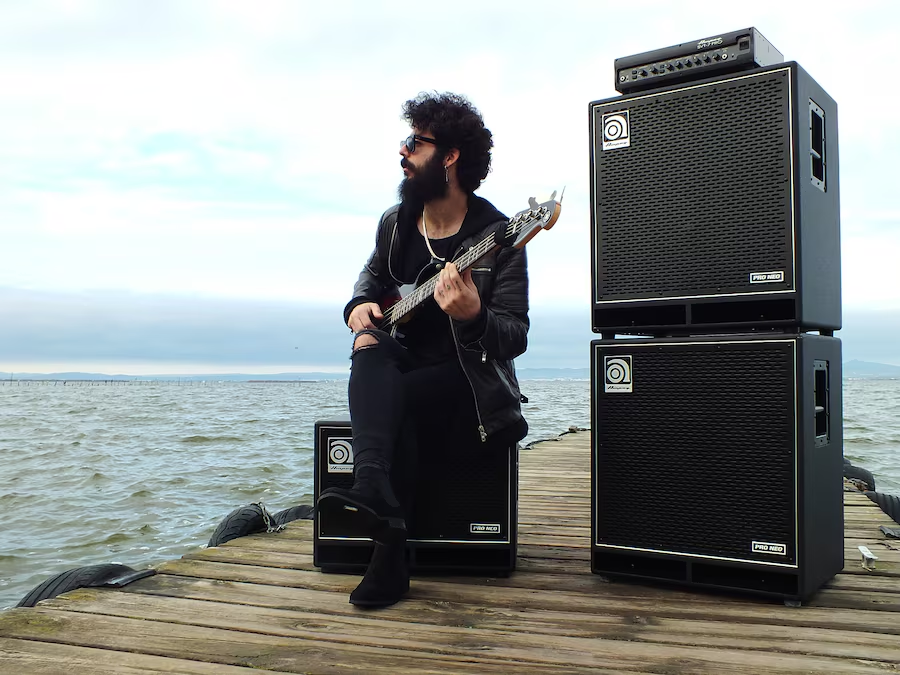
Rig Ampeg SVT head, two SVT 4×10 cabinets
Effects Boss GT-1B, Aguilar Tone Hammer
Strings Pitbull Strings Gold Series (.040 – .095)
Follow Vincen: HERE
For More on Vincen: Click Here
 By: Jon D'Auria