
Photos by Music Man
When Fender released its Jaco Pastorius Jazz Bass in 1999 that left one other renowned fretless bass heard ’round the world to be faithfully recreated and reborn. Welcome the Pino Palladino Icon Series and Artist Series StingRay Basses from Ernie Ball Music Man. The Icon Series, which will a have limited run of 15 hand-signed instruments [retail $5999.00], is an exact replica of Palladino’s sunburst 1979 fretless StingRay. It’s the instrument he played almost exclusively from 1981—when he saw and bought it for $350 at the old Sam Ash on 48th St in New York City—through 1996. That includes worldwide radio hits like Paul Young’s “Everytime You Go Away” and “Wherever I Lay My Hat (That’s My Home),” Don Henley’s “Sunset Grill” and “New York Minute,” Pete Townshend’s “Give Blood,” Elton John’s “Shoot Down the Moon,” Oletta Adams’ “Get Here,” Go West’s “Call Me,” Phil Collins’ “I Wish It Would Rain Down,” and Eric Clapton’s “Bad Love.” The Artist Series will have a continuous run of fretted and fretless versions [retail $3499.00].

For Palladino, his relationship with Brian Ball, CEO of Ernie Ball, began when he was with the Who and helped design the Ernie Ball Cobalt strings he used in the band. Of the process, he relates, “Brian contacted me about a year ago and said there was a lot of interest in my fretless bass and would I consider doing a signature version. I’m very fortunate to have a signature Precision Bass with Fender but I thought having a signature Music Man fretless made a lot of sense because it’s the instrument that defined me for so many years, and it was a great opportunity to bring to light that part of my career.” He continues, “I drove up to Ernie Ball headquarters in San Luis Obispo [California] for the day and I spent time getting to know the talented staff and seeing the wonderful family atmosphere they had. I left my bass with them for a couple of days and two weeks later they sent me the first prototype. It was a fine instrument but it felt different when I played it and I couldn’t figure out why. Finally I stood it up on the floor next to my bass, and my bass was a quarter-inch taller! I brought my bass back up to them and we figured out that on my bass the neck was slightly less set into the body, which meant on the prototype I could feel the difference when I rested my arm on the body and reached for the strings. They made the adjustment as well as some other tweaks, and when I got the next round of prototypes they were spot on.”
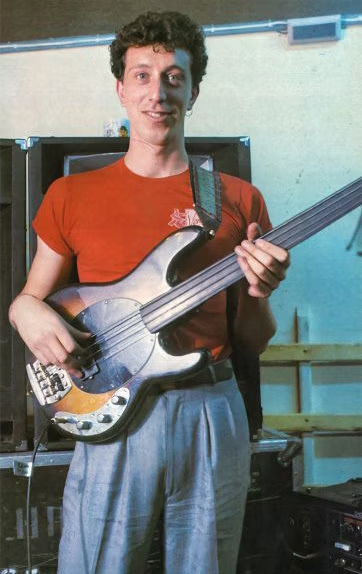
Those tweaks revealed fascinating details about the original bass, which we walked through with Palladino. The bodies of the new basses match the poplar of the original, with the Icon version including some aging (or relic-ing) and a Wales rugby club sticker on the back of the body. The strings-through-body bridge matches a quirk on the original in that it has brass saddles. Says Pino, “The team had never seen brass saddles on a StingRay before, which makes me suspect that my bass might have been made right at the end of Leo Fender’s tenure, where they just used whatever parts they had.” The black pickguard is 3-ply plastic, and the overall weight of the basses match the original, “Not too heavy, not too light.”
The pickups and preamp also required tweaking. “On my bass, boosting the bass and treble knobs gave it the standard Music Man scooped sound, which wasn’t optimal for fretless, so I used to only go halfway up on both, to get more of a singing, midrange sound. To accentuate that on the new basses the pickup guys added a whole lot more winding on the pickups.” Technically, the pickup is a vintage-style 5/8 Alnico V specially voiced and built to late-’70s specs with shorter pole pieces and .42 gauge wire. Likewise, the 2-band active preamp is custom-tuned with a 500k treble pot to match the original. “I asked them to back off the treble a bit. With any bass if you can hear a lot of noise between the notes from the high end it’s kind of off-putting.”

Turning to the neck, which matches the dark-tinted hard rock maple of the original, the team tried an oil and wax finish but Palladino preferred retaining the original polyester finish. The neck shape was also scrutinized. Pino offers, “There was a back-and-forth process where the neck guys would shave a bit off and hand it to me until it felt like my bass.” Music Man refers to it as having the custom asymmetrical neck profile of the orginal, which moves from a V shape down low to more of a C shape as you go higher up. The fingerboard is rosewood to match the original and retains the white side dots Pino relies on. “I never wanted fret lines, I find them almost confusing. It’s all hand position and muscle memory, like on an upright bass.” Elswhere, there’s a bullet truss rod, a signed neck plate featuring a 3-bolt attachment and micro-tilt adjustment, and a Graph Tech NuBone nut that was rounded off and darkened to match the original bone nut.
The headstock has Schaller tuners that match the original plus one practical adjustment: the string tree, which is between the D and G strings on the original has been moved to between the Aand D strings, except on the Icon Series basses, which are true to the original. Pino explains, “I used to have to be sure to wind my A string down on the string post, with a lot of winding on top of it to keep it low over the nut. The new string tree position eliminates that issue.”

On the string side, Brian Ball felt Palladino should have his own signature set of flat wounds, leading to the recent development and release of Pino Palladino Smoothie Flats [gauged .38-.54-.68-.98]. These are included on the Artist Series fretted and fretless line. For the Icon Series basses Pino developed a custom set of Ernie Ball Slinky Nickel Wounds, gauged .36-.55-.65-.90. Of the unusual gauges he reveals, “What I found with all of the Ernie Ball strings when I compared them to other brands of strings with the same gauge is that they inherently had more tension, so they felt heavier than the listed gauge. For the Icon set I experimented with the gauges until I came up with a set that sounded and felt like the strings I used on my original bass.” He adds, “The flatwounds sound great on the Icon bass, too, we just wanted to be authentic to the original round wound sound.”
The basses have already found their way into Palladino’s rotation, with the fretted version appearing in the video for “Taka,” the first single from Pino’s sophomore effort, That Wasn’t a Dream, with Blake Mills, dropping on August 22nd. Of the journey, he sums up, “It’s been a cool and rewarding process putting together these truly special basses. I’ve been getting some very positive responses. There are so many amazing young musicians out there, it will be interesting to see if the fretless bass makes a bit of a come back.”
Follow Pino: HERE
For more on the bass: Music Man
For more on Pino’s strings: Click Here
 By: Chris Jisi